
When people start looking for good-quality desi ghee, two terms often appear together: Bilona Ghee and A2 Ghee.
At first glance, they may sound like two different types of ghee. But there is an important distinction: Bilona refers mainly to the traditional method used to make ghee, while A2 refers to the type of beta-casein protein associated with the milk source.
So, are Bilona Ghee and A2 Ghee the same?
Not necessarily. A ghee can be A2 and made using the Bilona method, but the terms describe different things.
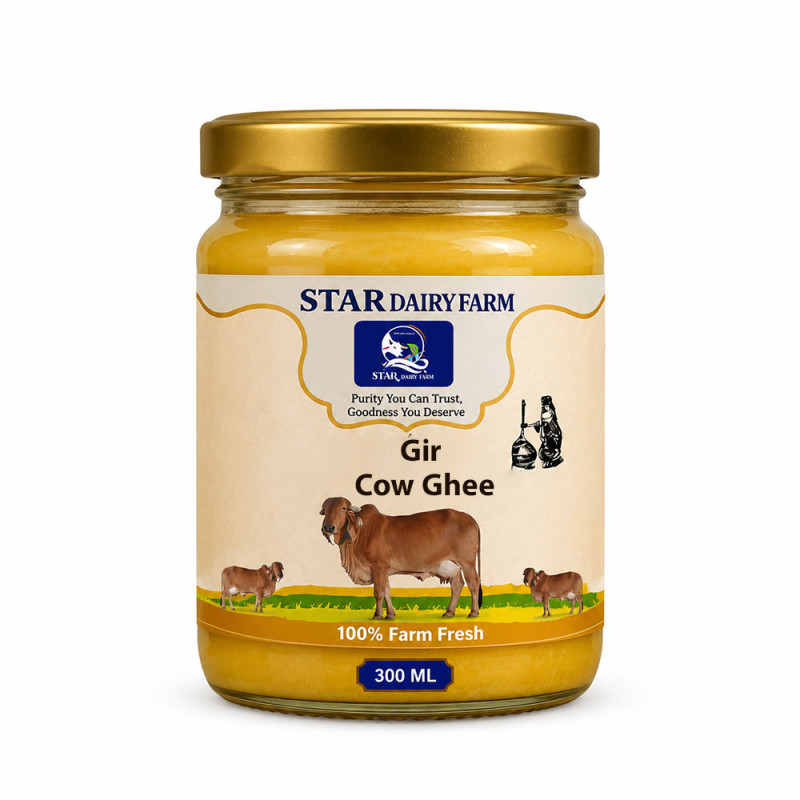
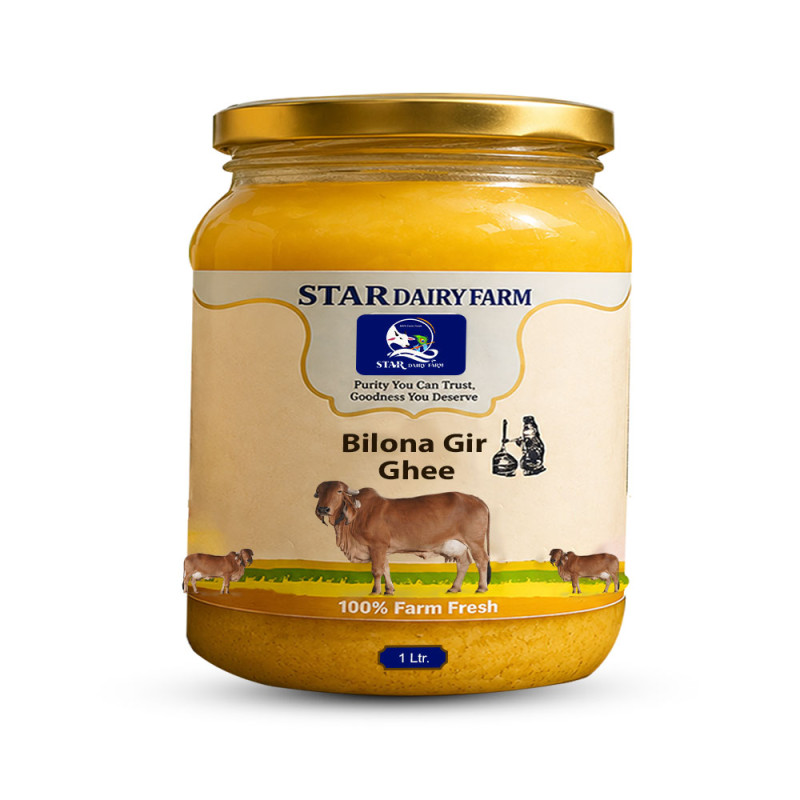
At Star Dairy Farms, we focus on providing quality A2 ghee with an emphasis on traditional preparation and careful sourcing. This guide explains the difference between Bilona Ghee and A2 Ghee in simple terms so buyers can understand what they are actually purchasing.
What Is A2 Ghee?
A2 Ghee is ghee prepared from milk marketed as containing the A2 type of beta-casein protein.
Milk naturally contains several proteins, including casein. A2 milk refers specifically to milk from cows that produce the A2 variant of beta-casein.
When this milk is converted into ghee, most milk solids and water are removed during the clarification process. Therefore, it is important not to assume that the final ghee contains the same protein composition as the original milk.
In the Indian market, A2 ghee is commonly associated with indigenous cow breeds and traditional dairy practices.
However, buyers should look beyond the words "A2 Ghee" on a label. The source of milk, manufacturing process, quality controls, purity and transparency of the supplier are all important.
What Is Bilona Ghee?
Bilona Ghee refers to ghee made using a traditional curd-churning method.
In the traditional Bilona process, milk is first converted into curd. The curd is then churned to separate butter. That butter is subsequently heated and clarified to produce ghee.
The basic traditional process can be represented as:
Milk → Curd → Churning → Butter → Heating → Ghee
This differs from some modern commercial processes where cream may be separated from milk and then processed into butter and ghee.
The word "Bilona" therefore describes the method of preparation, not a specific breed or milk protein type.
Bilona Ghee vs A2 Ghee: The Key Difference
The easiest way to understand the difference is this:
| Factor | Bilona Ghee | A2 Ghee |
|---|---|---|
| What does the term describe? | Preparation method | Milk/protein type |
| Main focus | Traditional churning process | A2 beta-casein milk |
| Requires A2 milk? | Not necessarily | Yes, if the A2 claim is genuine |
| Can use indigenous cow milk? | Yes | Commonly associated with A2-milk-producing cows |
| Can be traditionally prepared? | Yes | Yes |
| Can they be combined? | Yes | Yes |
| Same thing? | No | No |
This means Bilona and A2 are not competing definitions.
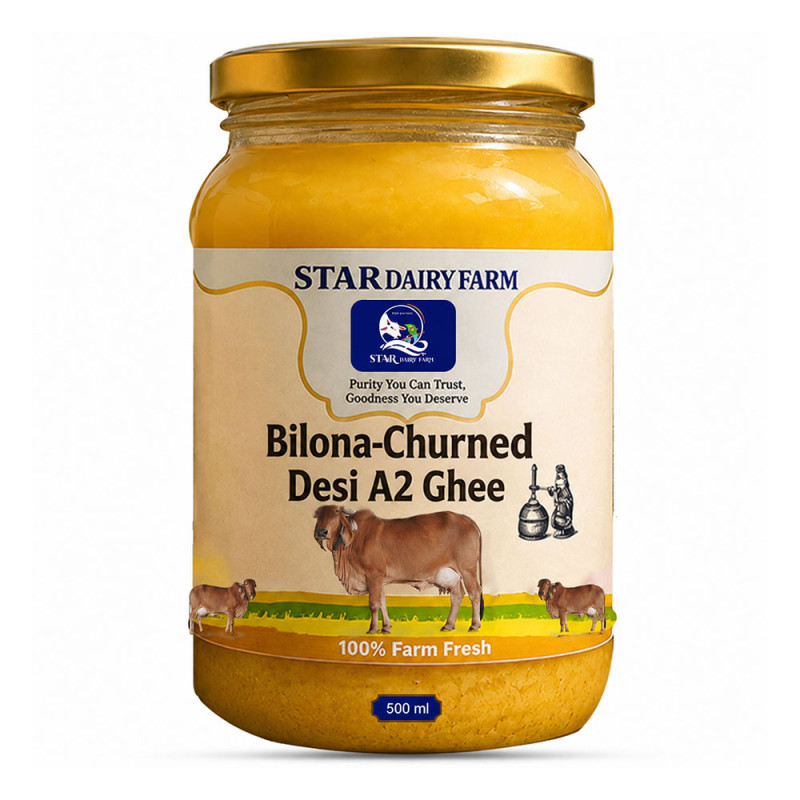
A product can actually be described as A2 Bilona Ghee when A2 milk is used and the ghee is prepared through a traditional Bilona-style process.
Is Bilona Ghee Always A2?
No.
This is one of the most common misunderstandings.
The word Bilona tells you about the processing method. It does not automatically tell you whether the milk used was A2.
For example, a producer could make Bilona ghee from milk without establishing an A2 milk claim. It would still be Bilona ghee because of the preparation method.
Therefore, if you specifically want A2 Bilona Ghee, check both aspects:
- What type of milk is being used?
- How is the ghee being prepared?
At Star Dairy Farms, we believe customers should understand the difference rather than simply choosing a product because the packaging contains popular terms.
Is A2 Ghee Always Bilona?
No.
Similarly, A2 Ghee does not automatically mean Bilona Ghee.
A2 milk can be processed using different dairy manufacturing methods. If the producer uses a different method rather than the traditional curd-churning approach, the resulting product may be A2 ghee but not Bilona ghee.
So:
A2 = related to the milk source/protein type
Bilona = related to the traditional preparation method
That distinction makes it much easier to understand product labels.
What Is A2 Bilona Ghee?
A2 Bilona Ghee combines both concepts.
It generally means:
A2 milk + traditional Bilona-style preparation = A2 Bilona Ghee
The traditional process involves converting milk into curd, churning the curd to obtain butter and then heating the butter to make ghee.
This process is often appreciated by consumers looking for ghee made using traditional Indian dairy practices.
For a buyer, however, the important point is to verify the supplier's claims and understand exactly how the product is manufactured.
How Is Traditional Bilona Ghee Made?
Let's look at the process more closely.
Step 1: Milk Collection
The process begins with milk collection.
For A2 Bilona Ghee, the milk should come from cows identified by the producer as producing A2-type beta-casein milk.
The quality of the raw milk has a direct impact on the overall quality of the finished dairy product.
Step 2: Milk Conversion Into Curd
Instead of directly separating cream, the traditional process involves allowing the milk to set into curd.
This is an important characteristic of the Bilona-style approach.
Step 3: Churning
The curd is churned to separate butter from the liquid portion.
Traditional descriptions often refer to wooden churners or "bilona" used for this process.
The churning stage is one of the defining features of traditional Bilona ghee preparation.
Step 4: Butter Collection
The butter separated during churning is collected.
This butter is then prepared for the final clarification process.
Step 5: Heating
The butter is heated carefully.
During heating, moisture evaporates and milk solids separate from the fat.
Step 6: Ghee Filtration
The clarified fat is separated from the remaining solids and filtered to obtain ghee.
The result is a golden, aromatic dairy fat with the characteristic flavour associated with traditionally prepared ghee.
How Is Regular A2 Ghee Made?
The exact process depends on the manufacturer.
A2 milk may be processed using modern dairy techniques before the fat is converted into ghee.
The important point is that the A2 designation alone does not tell you the manufacturing process.
This is why two products may both be marketed as A2 Ghee while having substantially different production methods.
For buyers, asking about the complete journey from milk collection to finished ghee can provide much more useful information than relying only on the product name.
Bilona Ghee vs A2 Ghee: Which One Is Better?
There is no universal answer that one is automatically "better."
It depends on what you are looking for.
Choose Bilona Ghee if your priority is:
- Traditional curd-to-butter-to-ghee preparation
- Traditional dairy processing
- Rich aroma and flavour associated with traditionally prepared ghee
- A product made using a more traditional approach
Choose A2 Ghee if your priority is:
- Ghee made from milk marketed as A2 milk
- Understanding the milk source
- A2-focused dairy products
Choose A2 Bilona Ghee if you want both:
- A2 milk source
- Traditional Bilona-style preparation
This combination is one reason A2 Bilona Ghee has become increasingly popular among consumers who prefer traditional dairy products.
A2 Ghee vs Bilona Ghee: What About Nutrition?
Ghee is primarily a source of fat and energy, regardless of whether it is marketed as A2 or Bilona.
It is important not to treat the words "A2" or "Bilona" as automatic guarantees of superior nutrition.
The nutritional composition of ghee depends on factors including the milk, processing conditions and manufacturing practices.
Also, because ghee is concentrated fat, it should be consumed as part of a balanced diet and in appropriate quantities.
For consumers, the bigger consideration should be purity, sourcing, processing, quality and transparency rather than assuming that one label automatically makes a product healthier.
Does Bilona Ghee Taste Different From A2 Ghee?
Taste can vary considerably depending on the milk source, preparation process, heating conditions and storage.
Traditional Bilona-style ghee is often appreciated for its:
- Rich aroma
- Distinctive dairy flavour
- Traditional taste
- Smooth texture
- Pleasant golden appearance
However, taste is subjective.
Two ghee products can have different flavours even when both are made from A2 milk because their processing methods and raw materials may differ.
At Star Dairy Farms, maintaining the natural character and traditional appeal of A2 ghee is an important part of our product approach.
Why Does the Milk Source Matter?
The source of milk is an important consideration when purchasing A2 ghee.
Consumers should ideally look for information about:
- Cow breed or milk source
- Milk collection practices
- Processing method
- Manufacturing location
- Purity and quality controls
- Packaging and storage
- Batch information
- Relevant testing or certification where applicable
A trustworthy supplier should be able to explain where its milk comes from and how the ghee is produced.
This is particularly important because terms such as "A2," "desi cow," "Bilona" and "traditional" are widely used in the market.
How to Identify Good-Quality A2 Bilona Ghee?
If you are buying A2 Bilona Ghee for your family, business, retail store or bulk requirement, don't judge the product only by its name.
Here are some practical things to check.
1. Check the Ingredient Information
Look at the label carefully.
A simple and transparent ingredient declaration is preferable to vague claims.
2. Ask About the Milk Source
A supplier should be able to explain the source of the milk used for its A2 ghee.
3. Ask About the Bilona Process
If a product is promoted as Bilona Ghee, ask whether the manufacturer follows the traditional process involving:
Milk → Curd → Churning → Butter → Ghee
4. Check Packaging
Good packaging protects ghee from moisture, contamination, light and external odours.
5. Check Batch Details
Look for manufacturing date, batch number, net quantity and other required label information.
6. Buy From a Transparent Supplier
A supplier who is willing to explain the sourcing and manufacturing process gives buyers greater confidence.
A2 Ghee and Bilona Ghee for Wholesale Buyers
The difference is particularly important for retailers, distributors, resellers, restaurants and other B2B buyers.
If you are sourcing ghee in bulk, don't simply ask:
"What is your ghee price?"
Instead, ask:
- Is it A2 ghee?
- What is the milk source?
- Is it Bilona prepared?
- What is the manufacturing process?
- What pack sizes are available?
- What is the minimum order quantity?
- What are the shelf-life details?
- How is the product packed?
- Can you provide product documentation?
- What is the wholesale price?
- Can you supply consistently?
These questions help you compare suppliers on quality and transparency, rather than price alone.
Why Choose Star Dairy Farms for A2 Ghee?
At Star Dairy Farms, our focus is on supplying quality A2 ghee while keeping the product and its sourcing as transparent as possible.
We understand that today's customers don't simply want a jar labelled "A2 Ghee." They want to know what they are buying.
Our approach focuses on:
Quality-Focused Sourcing
We pay attention to the source and quality of milk used for our dairy products.
Traditional Dairy Values
Traditional Indian dairy practices are an important part of our approach to A2 ghee.
Product Transparency
We believe customers should have clear information about the product they are purchasing.
Consistent Supply
For retailers, distributors and bulk buyers, consistency matters just as much as product quality.
B2B Supply
Star Dairy Farms can cater to buyers looking for A2 ghee for retail, wholesale, distribution and other commercial requirements.
If you are a retailer, distributor, restaurant, wholesaler or bulk buyer looking for A2 ghee, you can contact Star Dairy Farms to discuss wholesale pricing, available pack sizes and bulk supply requirements.
Bilona Ghee vs A2 Ghee: Simple Example
Imagine two jars of ghee.
Jar A
It is made from A2 milk but processed using a modern dairy method.
This can be called A2 Ghee.
Jar B
It is made from A2 milk, converted into curd, churned into butter and then clarified into ghee.
This can be described as A2 Bilona Ghee, assuming the producer's A2 and Bilona claims are accurate.
So the second product doesn't become A2 because of the Bilona process.
It is A2 because of the milk source, and Bilona because of the preparation method.
That's the key difference.
Common Misconceptions About A2 and Bilona Ghee
Misconception 1: Bilona Automatically Means A2
Not true.
Bilona describes a preparation method. It does not automatically establish the A2 status of the milk.
Misconception 2: A2 Automatically Means Bilona
Not true.
A2 describes the milk/protein type, while Bilona describes processing.
Misconception 3: A2 Ghee Contains Large Amounts of A2 Protein
This is an important point.
Ghee is primarily milk fat, and the clarification process removes most non-fat milk components. Therefore, consumers should not interpret an A2 ghee label as meaning the finished product is a significant source of A2 milk protein.
Misconception 4: Expensive Ghee Is Always Better
Price alone doesn't establish quality.
A buyer should consider milk source, processing, purity, packaging, testing, brand transparency and overall value.
Which Ghee Should You Buy?
The right choice depends on your expectations.
| Your Priority | Suitable Choice |
|---|---|
| Traditional preparation | Bilona Ghee |
| A2 milk source | A2 Ghee |
| A2 + traditional process | A2 Bilona Ghee |
| Traditional taste | Bilona-style Ghee |
| Wholesale A2 dairy product | A2 Ghee from a reliable supplier |
| Premium traditional positioning | A2 Bilona Ghee |
If you are purchasing for everyday household use, choose a product from a supplier you trust.
If you are purchasing for resale, focus on quality, documentation, packaging, pricing and reliable supply along with the product's positioning.
1. Is Bilona Ghee the same as A2 Ghee?
No. Bilona refers to the traditional preparation method, while A2 refers to the type of beta-casein associated with the milk source. A product can be both A2 and Bilona.
2. Is A2 Bilona Ghee better than regular ghee?
A2 Bilona Ghee combines an A2 milk source with a traditional preparation method. Whether it is the right choice depends on your preferences for sourcing and processing.
3. Is every Bilona Ghee made from A2 milk?
No. Bilona refers to the preparation process. The milk source needs to be considered separately.
4. Is every A2 Ghee made using the Bilona method?
No. A2 ghee can be produced using different manufacturing processes.
5. What does Bilona mean?
Bilona refers to the traditional practice of converting milk into curd, churning the curd to obtain butter and then clarifying the butter into ghee.
6. What does A2 mean in A2 Ghee?
A2 generally refers to the A2 variant of beta-casein associated with the milk used to make the ghee.
7. Can A2 Ghee be made using the Bilona method?
Yes. When A2 milk is used and the traditional Bilona-style process is followed, the product can be marketed as A2 Bilona Ghee, subject to the accuracy and substantiation of those claims.
8. How can I choose a good A2 Ghee supplier?
Look for transparency about milk sourcing, manufacturing method, ingredients, packaging, batch information, quality controls and supply capabilities.
9. Is Bilona Ghee suitable for wholesale buyers?
Yes. Bilona ghee can be positioned as a premium traditional dairy product for retailers, distributors and other B2B buyers. However, buyers should evaluate pricing, consistency, packaging and supplier reliability before placing bulk orders.
10. Does Star Dairy Farms supply A2 Ghee?
Yes. Star Dairy Farms is an A2 Ghee supplier, serving customers looking for quality A2 ghee and bulk/wholesale supply requirements. Buyers can contact the company to discuss product availability, pack sizes, pricing and commercial requirements.
So, are Bilona Ghee and A2 Ghee the same?
No — but they can be combined in one product.
The easiest way to remember the difference is:
A2 tells you about the milk/protein type. Bilona tells you about the preparation method.
Therefore:
A2 Ghee ≠ Bilona Ghee
but
A2 Milk + Bilona Preparation = A2 Bilona Ghee
For consumers, the most important thing is not simply choosing the product with the most attractive label. Look at the milk source, preparation method, product information, quality practices and supplier transparency.
At Star Dairy Farms, we aim to make A2 ghee sourcing easier for customers, retailers, distributors and bulk buyers by focusing on quality, transparency and dependable supply.
If you are looking for A2 Ghee from a reliable supplier for personal use, retail or wholesale requirements, connect with Star Dairy Farms to discuss your requirement and get the latest product and bulk pricing information.
Star Dairy Farms – A2 Ghee Supplier
Quality dairy products, traditional values and dependable supply for modern customers.


